
Why Do Winnipeg Homeowners Confuse Quartzite with Quartz?
Walk into almost any kitchen showroom in Winnipeg and ask about countertop options. Within minutes, the words “quartz” and “quartzite” will come up – often used as if they mean the same thing. But they don’t. These are two completely different materials, and mixing them up can lead to real problems: wrong maintenance routines, unexpected damage, and a countertop that doesn’t perform the way you expected.
If you’ve been researching premium quartzite countertops in Winnipeg and found yourself more confused after reading a few websites than before, you’re not alone. This confusion is incredibly common, and there are specific reasons why it keeps happening. This blog explains exactly why homeowners mix up these two materials, what makes them different, and how to make sure you’re choosing the right one for your home.
Why the Confusion Starts With the Name Itself
The single biggest reason homeowners confuse these two materials is the name. “Quartz” and “quartzite” look almost identical in print and sound nearly the same when spoken.
This isn’t a problem unique to homeowners, either. Contractors, online retailers, and even some showroom staff use the terms interchangeably when they shouldn’t. When a homeowner sees “quartz countertop” listed in one place and “quartzite countertop” listed somewhere else with similar-looking slabs and overlapping price ranges, the natural assumption is that they’re the same thing or just different spellings of the same product.
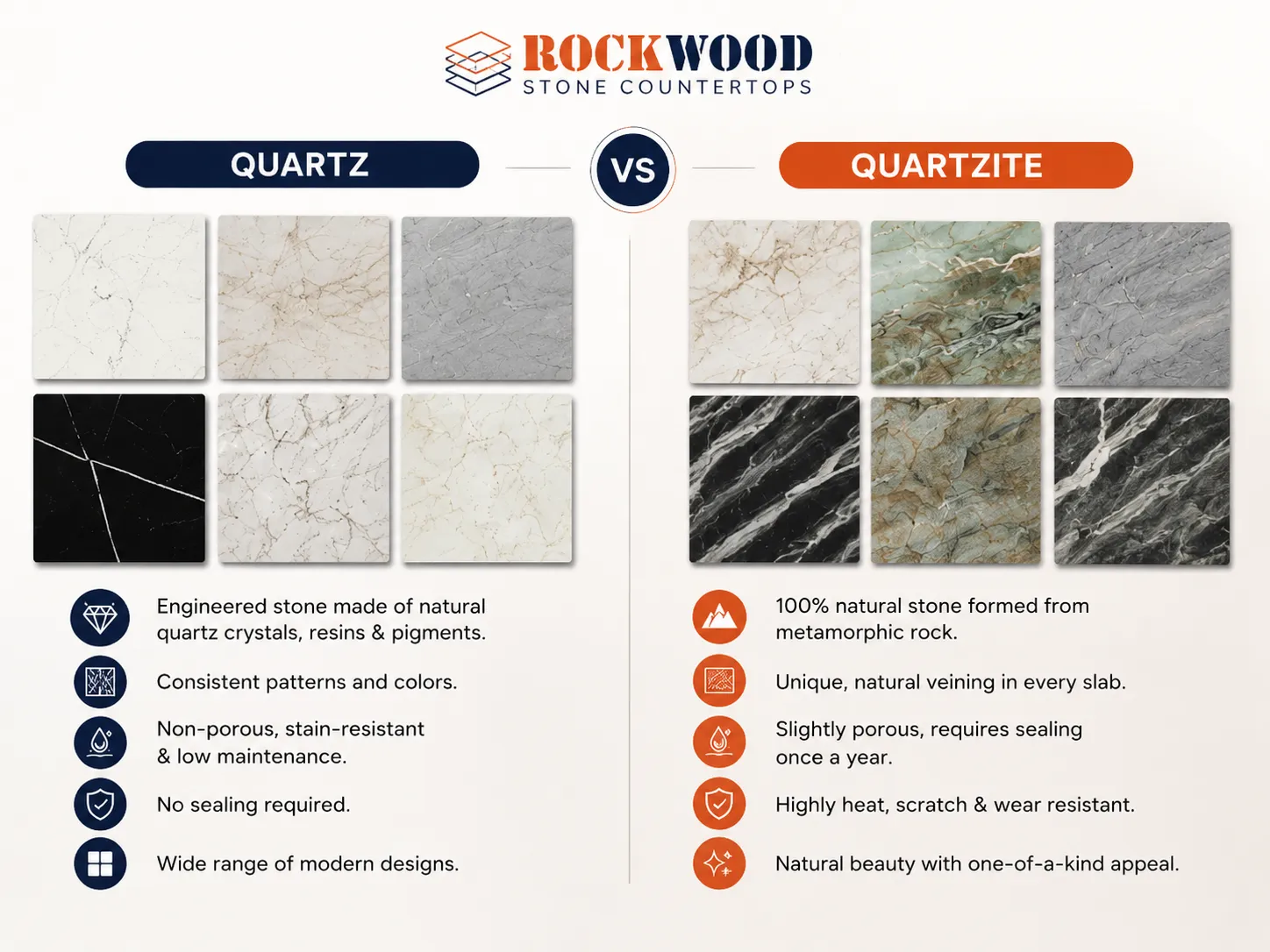
In reality, quartz is an engineered material made in a factory using ground stone crystals mixed with resins and pigments. Quartzite is a naturally occurring metamorphic rock formed when sandstone undergoes intense heat and pressure deep underground over millions of years. They couldn’t be more different in origin, composition, or behaviour.
How Showrooms and Online Listings Make It Worse
Walk through any home improvement store in Winnipeg, and you’ll notice something frustrating: product labelling is inconsistent. Some slabs that are actually quartzite get labelled as “natural quartz.” Some engineered quartz products get described using language that sounds like natural stone. Add in the fact that both materials can be white, grey, or veined in ways that look similar at a glance, and the visual confusion compounds the naming confusion.
Online shopping makes this worse. Search for countertops on major home decor platforms and you’ll find product listings that use “quartz” and “quartzite” interchangeably in the same description. A homeowner trying to do their research before visiting a showroom ends up with a muddled understanding before they’ve even seen a real slab.
A homeowner who thinks they’re buying low-maintenance engineered quartz but actually purchases quartzite will be caught off guard when they’re told they need to seal it every year. The reverse situation – someone expecting the natural beauty and heat resistance of quartzite but getting engineered quartz – can be equally disappointing.
The Visual Similarity Problem
Both materials can look similar, especially in lighter colorways. White quartzite and white engineered quartz can appear nearly identical in photographs and even in person if you don’t know what to look for.
Natural quartzite has a certain depth and movement to its veining that comes from genuine geological formation. No two slabs are the same. The patterns flow organically, and the surface has a subtle texture that varies across the stone. If you’re drawn to styles like Super White, Taj Mahal, or Calacatta quartzite, it’s worth understanding what you’re actually looking at.
Engineered quartz, on the other hand, has a more uniform appearance. The veining and color patterns are applied during manufacturing, which means they repeat across slabs in predictable ways. Premium brands like Cambria and Silestone have improved significantly in mimicking the look of natural stone, which makes visual distinction even harder for someone without experience handling both materials.
What Happens When You Treat Them the Same Way
This is where the confusion moves from being a minor inconvenience to a real problem. Quartz and quartzite require different care routines, and treating one like the other can cause damage.
If you treat quartzite like quartz and skip the sealing, the stone’s natural porosity will leave it vulnerable to staining from red wine, coffee, lemon juice, and cooking oils. Quartzite needs to be sealed once a year using a penetrating stone sealer. This is a straightforward process, but it’s a non-negotiable part of ownership.
If you treat quartz like quartzite and place hot pots or pans directly on the surface, the resin content in engineered quartz can discolor, blister, or crack. Natural quartzite handles heat far better because it contains no synthetic materials. Using quartz as if it has the same heat tolerance as a fully natural stone can lead to permanent surface damage that isn’t covered under most warranties.
Getting these maintenance habits wrong doesn’t just affect the surface – it can void your warranty and reduce the lifespan of what is likely a significant financial investment.
Why Winnipeg Homeowners Specifically Need to Get This Right
Winnipeg’s climate is one of the most extreme in Canada. Winters drop well below -30°C and summers regularly hit 35°C. While countertops are inside the home, this temperature range affects certain spaces more than people expect – sunrooms, mudrooms near exterior doors, and areas near large windows can experience more temperature variation than a standard insulated kitchen wall.
For outdoor kitchen installations, which are becoming more common in Winnipeg during summer months, the material choice matters even more. Engineered quartz is generally not recommended for outdoor use because UV exposure can cause the resin to fade and the surface to degrade over time. Natural quartzite holds up far better outdoors because it contains no synthetic materials that react to sunlight or temperature extremes.
Understanding which material you actually have – not just what you think you have – is essential before deciding where to install it and how to care for it through Winnipeg’s seasonal extremes.
How to Tell Quartz and Quartzite Apart Before You Buy
There are a few reliable ways to distinguish between these two materials when you’re standing in a showroom or reviewing options online.
First, ask directly whether the slab is engineered or natural stone. Any reputable supplier should be able to answer this question immediately. If the answer is vague or uncertain, that’s a red flag worth noting.
Second, look at the back of the slab if possible. Natural quartzite typically shows raw stone texture on the unfinished underside. Engineered quartz often has a more uniform, processed appearance on the back.
Third, check for pattern repetition. If you notice the same vein pattern appearing multiple times across different sections of a large slab, it’s almost certainly engineered. Natural stone doesn’t repeat.
Fourth, ask about maintenance requirements. If the supplier tells you no sealing is ever needed, the material is almost certainly engineered quartz. Natural quartzite always requires periodic sealing.
If you’re specifically interested in lighter tones and natural stone options, taking time to explore white quartzite styles before visiting a showroom gives you a better visual reference point and helps you ask sharper questions.
The Practical Takeaway for Winnipeg Homeowners
The confusion between quartz and quartzite is understandable given the naming overlap, similar aesthetics, and inconsistent industry labelling. But it’s a confusion that’s worth resolving before you spend thousands of dollars on a countertop installation.
Quartz is a reliable, low-maintenance engineered surface that suits busy households and modern kitchen designs. Quartzite is a premium natural stone with unique character, superior hardness, and better heat resistance – but it asks a little more from you in terms of maintenance. Neither is universally better. The right choice depends on your kitchen habits, your design preferences, and how much maintenance you’re willing to commit to.
The most important thing you can do before making a decision is to work with a countertop supplier who clearly knows the difference, can show you actual slabs of both materials side by side, and takes the time to explain what you’re actually looking at.
For Winnipeg homeowners who want straightforward, honest guidance on natural stone countertop options, Rockwood Stone Countertops is a trusted local resource with the expertise to help you choose the right material with confidence.
People Also Ask
What is the main difference between quartz and quartzite?
Quartz is an engineered material made from ground stone crystals mixed with resins and pigments. Quartzite is a 100% natural metamorphic rock formed from sandstone under extreme geological pressure. Quartz requires no sealing and has lower heat tolerance. Quartzite needs annual sealing but handles heat better and offers unique natural aesthetics.
Why does quartzite need sealing, but quartz doesn’t?
Quartzite is a natural stone with slight porosity, meaning liquids can slowly penetrate the surface and cause staining if left unsealed. Engineered quartz is manufactured to be non-porous, so liquids sit on the surface and can be wiped away without absorption. Sealing quartzite once a year closes those pores and protects the stone.
Can you use quartzite in an outdoor kitchen in Winnipeg?
Yes, quartzite is a better choice than quartz for outdoor kitchens in Winnipeg. Engineered quartz contains resins that can degrade under UV exposure and temperature extremes. Natural quartzite contains no synthetic materials and holds up better in outdoor settings, though it still needs to be sealed regularly to protect against moisture and weathering.
How do I know if a slab is quartz or quartzite at a showroom?
Ask the supplier directly whether the slab is engineered or natural stone. Check for pattern repetition – engineered quartz often repeats vein patterns across the slab, while natural quartzite does not. Ask about maintenance requirements – if no sealing is needed, it’s almost certainly engineered quartz. Look at the back of the slab for raw stone texture.